Laguna Pueblo: A Photographic History by Marmon Lee & Corbett Tom
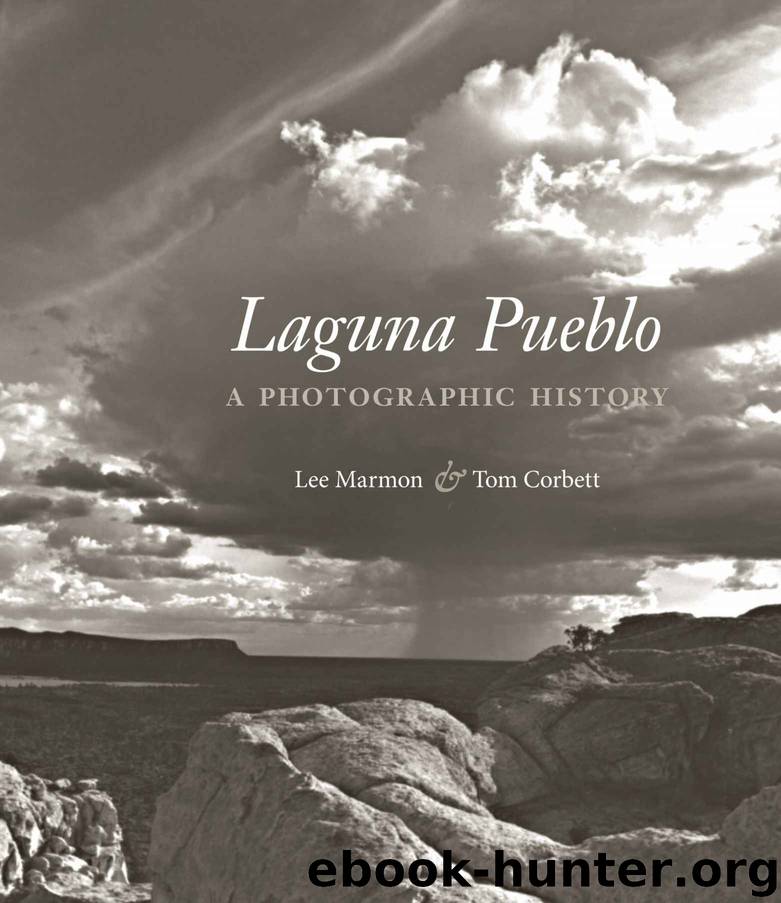
Author:Marmon, Lee & Corbett, Tom [Marmon, Lee]
Language: eng
Format: epub
Publisher: University of New Mexico Press
Published: 2015-02-22T05:00:00+00:00
The Jackpile Mine Aerial View #2 . Photo by Lee Marmon (1958)
CHAPTER ELEVEN
Customs and Culture
Material from this chapter was transcribed by Tom Corbett from recorded interviews with Lee Marmon .
I was fortunate to be able to document the changing culture of Laguna in photographs over the years. Some of the customs I observed and photographed are not practiced anymore. Others, like the dances and other religious activities, will continue unchanged. I hope these photographs will help to pass the old customs and activities on to future generations.
A few years ago I made a copy of an old family photograph of my aunt Edith and aunt Alice. It was taken in about 1912. The photographer took great pains to get them dressed up in buckskin with authentic headbands and to pose beside a mountain stream with tall trees in the background. It was wonderful for me to look at the photograph and realize that my aunts were once young and beautiful. I had only known them many years later after their youth had passed. That photograph brought back memories of the time I spent as a young boy listening to stories my aunt Alice remembered hearing about the Civil War from her father, Walter G. Marmon, who first came to New Mexico in 1868 to survey for the government. I am telling the stories about these photographs now to show how photography can reach across time to bring back images of long ago and how it can change a person’s feelings about some long-forgotten person, event, or place.
Other changes have occurred that I cannot document in photographs. As I walk through the village, I notice people speaking to each other less in Keresan and more in English. The Laguna Constitution provides for one member of the tribal council to be an interpreter. This position was necessary in the past because the meetings were held in Keresan. Some of the tribal officials did not speak English in the old days, but now just about everybody does. Sadly, many of the young people today do not speak Keresan. The old stories and legends, the basis for the Laguna culture, used to be passed down by word of mouth in Keresan, from older generations to younger generations, and now some of the details and meanings of the stories are lost in translation. The trend appears to be reversing, however. The Laguna language is being taught in the Head Start program, and classes in Keresan are now offered at the Laguna-Acoma High School.
Another thing I notice is that the people today are more prosperous than they were in earlier years. They have modern appliances and use cell phones. Not many families had cars when I was growing up in Laguna, and they did not travel very much. When someone did get a car, it usually was an older vehicle, not in good shape. Today almost every family has a car, and most of them are new or relatively new, and people travel a lot.
Health care has improved markedly.
Download
This site does not store any files on its server. We only index and link to content provided by other sites. Please contact the content providers to delete copyright contents if any and email us, we'll remove relevant links or contents immediately.
| Anthropology | Archaeology |
| Philosophy | Politics & Government |
| Social Sciences | Sociology |
| Women's Studies |
Cecilia; Or, Memoirs of an Heiress — Volume 1 by Fanny Burney(32654)
The Great Music City by Andrea Baker(32621)
Cecilia; Or, Memoirs of an Heiress — Volume 2 by Fanny Burney(32025)
Cecilia; Or, Memoirs of an Heiress — Volume 3 by Fanny Burney(32005)
We're Going to Need More Wine by Gabrielle Union(19121)
All the Missing Girls by Megan Miranda(16417)
Pimp by Iceberg Slim(14713)
For the Love of Europe by Rick Steves(14661)
Bombshells: Glamour Girls of a Lifetime by Sullivan Steve(14152)
Norse Mythology by Gaiman Neil(13474)
Talking to Strangers by Malcolm Gladwell(13474)
Fifty Shades Freed by E L James(13307)
Mindhunter: Inside the FBI's Elite Serial Crime Unit by John E. Douglas & Mark Olshaker(9449)
Crazy Rich Asians by Kevin Kwan(9360)
The Lost Art of Listening by Michael P. Nichols(7568)
Enlightenment Now: The Case for Reason, Science, Humanism, and Progress by Steven Pinker(7369)
The Four Agreements by Don Miguel Ruiz(6853)
Bad Blood by John Carreyrou(6686)
Weapons of Math Destruction by Cathy O'Neil(6392)
